
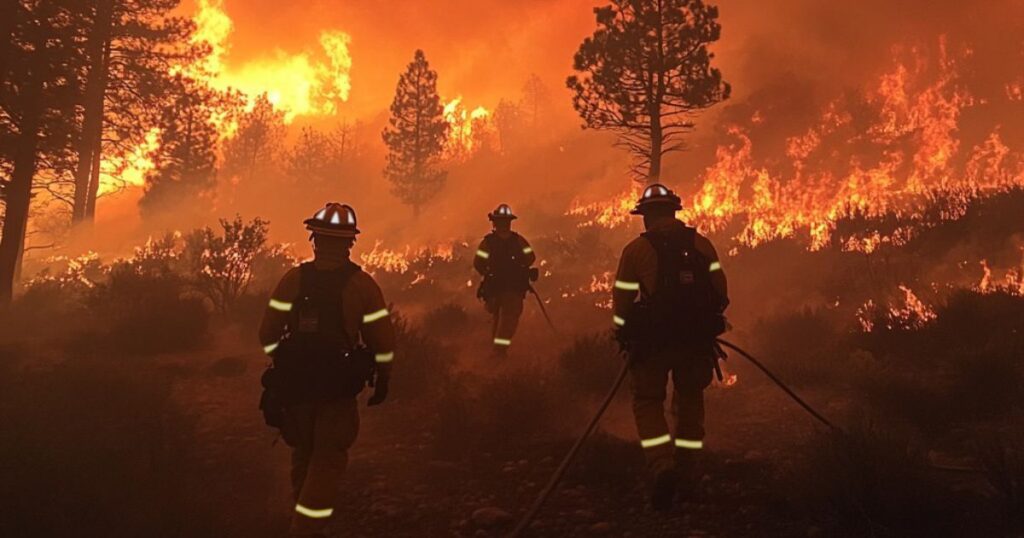
As wildfires grow larger, longer, and more complex, one critical firefighter safety standard has remained largely unchanged: visibility.
Most people remember the wildfires in California in 2025 that burned through complete neighborhoods. What you may not remember are the tens of thousands of other wildfires that raged across the country.
The numbers from the last two fire seasons are not easy to grasp:
- In 2024, nearly 65,000 wildfires burned across the United States, a 15% increase over 2023
- Total acres consumed jumped from 2.7 million to nearly 9 million in a single year, a 231% increase
- In 2025, more than 72,000 fires burned over five million acres, requiring record mobilization of personnel, incident management teams, ground crews, and aerial assets
And 2026 is already well underway, including major fires in Utah, Arizona, and California, not to mention Portugal, Spain, France, and Greece. (You can even bet on wildfires on prediction markets now).
That level of destruction is attention-getting. What gets less attention is the shift in the nature of those wildfires: these fires burn longer, in more places, at hours when bright-colored turnout and PPE gear offers limited protection. The crew responding to them are working in conditions that look increasingly unlike the conditions their gear was designed for over thirty years ago.
Which raises a very interesting, and important, question: when was the last time wildland firefighter visibility standards kept pace with the reality of wildland fires themselves?
The answer is as instructive as it is unsatisfying, and it points to a visibility gap that the safety apparel industry is uniquely positioned to shed light on and help close.
What the wildland firefighting standards say (and what they don’t)
Structural firefighting PPE has required reflective trim for decades. NFPA 1970 is the structural firefighting standard (which combines standards 1971 (Structural), 1975 (Emergency Services), 1981 (SCBA), and 1982 (PASS)), explicitly requires the outer shell of protective clothing to have reflective trim to enhance visibility under smoke-laden and other adverse conditions. That requirement is mandatory, not optional. There’s no local discretion involved.
NFPA 1950, the governing standard for wildland firefighting PPE (which combines NFPA 1951 (Technical Rescue), 1977 (Wildland and Urban Interface), and 1999 (Emergency Medical), takes a different approach. Visibility enhancement for wildland firefighting protective clothing was added as a nonmandatory option, should purchasers choose to specify such enhancements in their purchase specifications.
What’s curious is, the standards acknowledge that visibility matters. NFPA 1970 states that “the authority having jurisdiction should conduct a risk assessment and determine the level of visibility required for work apparel based on the anticipated use.” Tellingly, that risk assessment and the decision that comes from it, belongs to the local agency.
So, there is no national minimum reflective requirement for wildland gear.
Under the Canadian equivalent standard CGSB 155.22, high-visibility components including retroreflective and fluorescent elements are similarly optional, though they also may be required locally.
Europe, on the other hand, has gone beyond “optional” and met this issue head-on. EN ISO 15384:2020, the European and international standard governing wildland firefighter protective clothing, mandates specific reflective and fluorescent placement on compliant garments: horizontal bands encircling the torso, horizontal bands completely encircling each arm, and each leg on pants. It’s a placement requirement, not a recommendation. Walk the floor at Interschutz, the German fire service expo that draws manufacturers and agencies from across the continent, and you see the standard in practice: reflective trim on wildland gear is simply expected.
In other words: structural firefighters in the US have mandatory reflective trim requirements. Wildland firefighters, who operate in equally demanding and arguably more variable visibility conditions, do not. That is the visibility gap. It is documented, it has major practical and safety significance, and it deserves a direct conversation about why and how to remedy it.
Why the gap matters more now than it did in 1993
The Technical Committee on Fire Service Protective Clothing and Equipment began work on wildland standards in April 1989, with the goal of outlining thermal protection requirements that would provide lifesaving protection without imposing extraordinary heat stress loads. The NFPA 1977 was first established in 1993. The standard addressed the conditions of its time: primarily daylight operations in relatively predictable terrain, where high-contrast yellow Nomex provided adequate crew visibility.
The good old days.
Wildfires outside the traditional fire season are becoming more common, driven by earlier snowmelt, later fall and winter precipitation, or just less precipitation overall. Whether you call it climate change or something else, those conditions are reality and they extend fire risk well beyond what crews historically planned around.
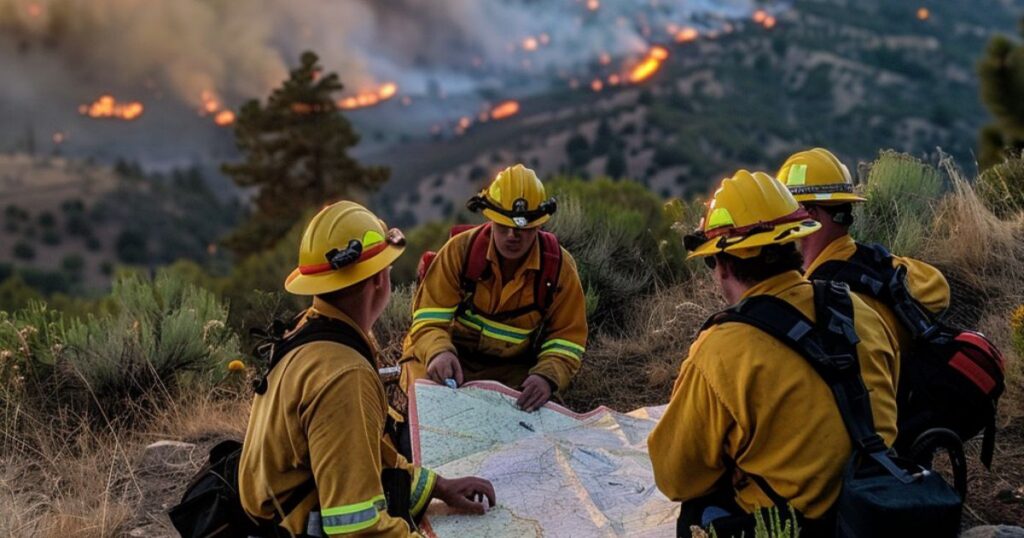
Crews increasingly work overnight. Wildland firefighters typically work 12-to-16-hour shifts, with deployments running up to 14 days under federal policy — extendable to 21 days at the request of an Incident Commander with agency approval. Multi-week deployments mean night operations are routine, mixed crews sharing fire lines with vehicles, aircraft, and equipment from multiple agencies. And they mean the conditions under which a wildland firefighter needs to be seen are exactly the conditions under which color alone fails.
Fluorescent material, the traditional visibility solution for wildland gear, only works in ultraviolet light. It does nothing after dark. Conversely, retroreflective trim returns light to its source, including vehicle headlights, spotlights, flashlights, aircraft lighting, etc., and works precisely when fluorescent color does not. Which makes the operational case for mandatory retroreflective requirements on wildland firefighting gear stronger today than at any point in the standard’s history.
The National Interagency Fire Center tracks wildland fire data nationally. The sheer scale of what those numbers are describing, in crew hours, incident complexity, nighttime deployment, makes the “optional” reflective designation in NFPA 1950 look like a relic of another time. It also looks somewhat irresponsible.
The invisible design problem hiding in plain sight
Here is where the conversation gets more technically specific and more relevant for manufacturers, suppliers, and intermediaries.
The argument for adding reflective trim to wildland gear is straightforward. The execution is not. Wildland firefighting gear and structural firefighting gear are different systems built for different demands. The necessary level of protection from radiant heat must be balanced against the risk of heat stress from too many layers. EN ISO 15384:2020+A1:2021, the international standard for wildland firefighter protective clothing, explicitly recognizes this balance — emphasizing breathability and firefighter visibility alongside radiant heat protection as core performance requirements. It’s extra critical that wildland high-visibility safety apparel (HVSA) should not increase the heat stress on firefighters already working under high ambient temperatures and arduous physical conditions.
In a wildland firefighting context, continuous retroreflective trim creates a surface barrier across certain areas of a garment, and that barrier can trap heat. Where a crew member may be hiking miles through rough terrain in August carrying an equipment load before the work even begins, any gear component that compounds heat stress is a component that works against the safety mission. SRI Labs testing has documented what experienced fire crews already know: standard continuous trim, even perforated versions, degrades vapor permeability and extends thermal decay time. In plain English, the firefighter absorbs heat the HVSA garment was designed to release.
Segmented, non-continuous retroreflective trim, like our own AIREX,Ⓡ addresses this directly. It delivers certified retroreflective performance while preserving the breathability and thermal characteristics of the underlying garment. The firefighter gets the visibility, the gear breathes the way it was engineered to breathe. No trade-off between visibility and thermal performance.
While segmented retroreflective trim engineering is ideally suited to the wildland firefighting environment, it is notably absent in the NFPA 1950 visibility framework. That’s because, again, the framework is optional and nonspecific. Getting retroreflective trim requirements into the regulatory standards matters as much as getting the trim onto garments in the first place.
The materials conversation is also changing
Manufacturers advocating for reflective trim components on wildland PPE gear are dealing with a second set of complications alongside performance requirements: PFAS.
PFAS, or per- and polyfluoroalkyl substances, have been widely used in textile manufacturing for their water and oil resistance properties. That is changing fast. California and New York both enacted PFAS bans in apparel effective January 1, 2025, with additional states following. California’s AB 1817 prohibits manufacture, distribution, and sale of new textile articles containing intentionally added PFAS; New York’s S.1322 prohibits sale of any new apparel containing intentionally added PFAS.
Illinois has enacted requirements for manufacturers to report known uses of PFAS in firefighting gear and personal protective equipment specifically, effective January 2026, which directly targets the PPE category.
Overseas, France banned the manufacture, import, export, and sale of PFAS-containing textiles effective January 2026, with full phase-out scheduled by January 2030, and the EU is advancing comprehensive PFAS restrictions under REACH.
For manufacturers making wildland firefighting gear, it means that reflective trim which bonds reliably to FR fabrics without PFAS is not a consideration for “someday,” it is a procurement question right now. SRI has been at this a long time, and thanks to continuous research at SRI Labs we saw this reality coming. That’s why all versions of AIREX. including FR and IW. are made to bond effectively to fabrics with or without PFAS. SRI products meet the performance requirements without creating a compliance problem. As PFAS restrictions continue to expand across US states and international markets, that matters both for domestic programs and for manufacturers supplying European agencies.
What closing the visibility gap would look like
Safe Reflections has worked alongside safety apparel manufacturers, procurement agencies, and regulatory bodies long enough to have an opinion on this. And that is, the “optional” designation for retroreflective trim on wildland firefighting gear belongs to a fire environment that no longer exists.
A reasonable mandatory framework for wildland firefighting reflective requirements would address three things:
- Minimum retroreflective area and placement for 360-degree visibility: specifying horizontal band placement on the torso, arms, and legs to ensure a firefighter is visible from any angle, in any light condition, to any approaching vehicle, aircraft, or crew member.
- Construction and placement requirements that preserve the wearer’s full range of motion: specifying not just where reflective materials must appear, but ensuring they don’t restrict movement at critical flex points. This is where segmented trim has a meaningful advantage over thicker, stiffer sew-on products: its flexibility allows compliant placement in locations that continuous trim simply can’t accommodate without compromising mobility.
- Performance standards that account for the extended field use and repeated laundering that wildland gear actually sees: including compliance with high-visibility standards such as EN ISO 20471 and ANSI/ISEA 107, and design criteria governing placement and coverage.
Ultimately, the wildland fire environment has changed enough, and is continuing to change fast enough, that the standards conversation needs to catch up quickly.
The wildland firefighting crews on those fire lines are working long hours in harder conditions in more places than the 1993 committee anticipated. They deserve HVSA gear with a mandatory visibility baseline.
Find Out Which SRI Solution Is Right for Your Application
Bring your specific retroreflectivity use conditions to the SRI team, whether to discuss material selection and performance requirements, request samples, or run a pre-production compatibility evaluation through SRI Labs.
Recent Resources
What Europe Knows About Wildland Firefighter Visibility That the US Doesn’t (but should)
With record-breaking wildfire seasons driving unprecedented cross-border deployments, the gap between European and U.S. wildland firefighter visibility requirements has become a growing
The Visibility Gap: Why Wildland Firefighters Deserve More Than Optional
Wildland fires have become larger, more frequent, and increasingly likely to require nighttime operations, yet current U.S. wildland firefighting standards do not

The Future of Visibility: How Reflective Graphic Transfers Are Transforming Safety Apparel
Reflective graphic transfers represent a genuine step forward in how reflective materials can be applied, designed, and integrated into modern safety garments,