
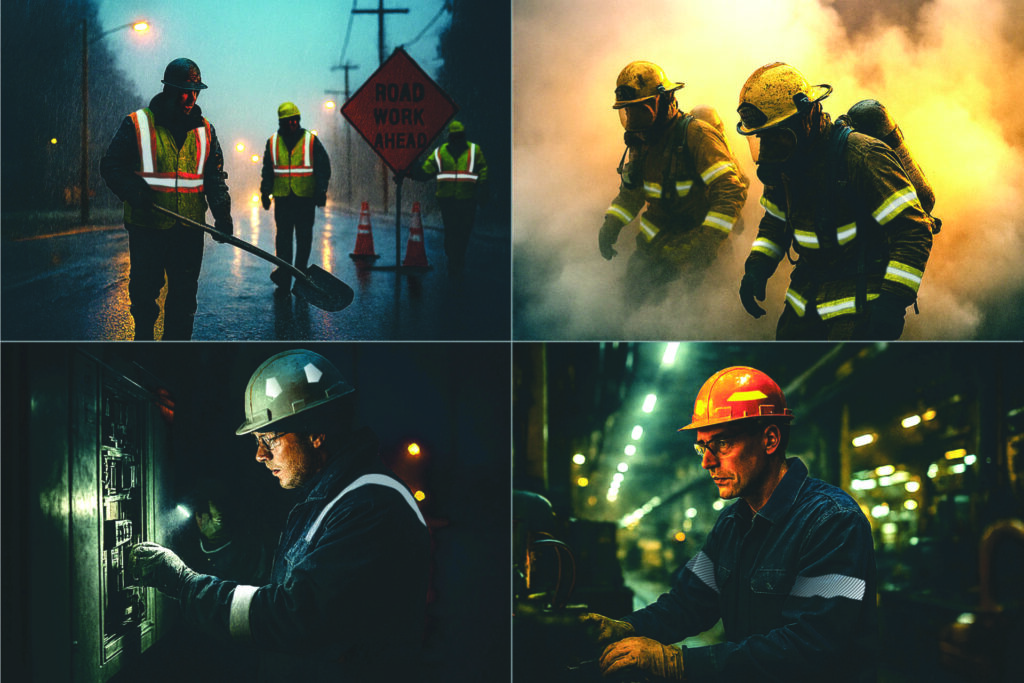
From frontline workers to trusted uniform partners, this year reminded us that real progress in reflective safety starts with real collaboration.
It’s easy to talk about reflective safety in abstract terms – standards, specs, compliance checkboxes.
But when you spend time in the real world of HVSA, one thing becomes clear fast: visibility is personal. It’s about workers who put on a vest at 4:30 a.m. in freezing rain. Road crews in heavy traffic, firefighters in dense smoke, utility crews working all hours, industrial teams surrounded by machines and movement.
It’s about the people who depend on their reflective safety gear, and the partners who make sure that gear is worth depending on.
As 2025 comes to a close, we want to take a moment to thank everyone who plays a part in making high-visibility safety possible: the workers who wear it, the manufacturers who create it, and the industry partners who continue to raise the bar for what “safe” really means.
Thank you to the people who show up where visibility matters most
Whether it’s road work, oil and gas, utilities, emergency services, or transportation logistics, reflective safety gear is essential. And the folks wearing that gear aren’t “end users,” they’re people, with homes and families waiting for them. They’re the reason we do what we do.
They work in high-risk, high-stress environments: moving vehicles, low visibility, extreme weather, chaotic job sites, chemical exposure, and unforgiving machinery. Safety in these situations requires constant vigilance, innovation, and trust.
At Safe Reflections, we’re proud to support the people who do this work. Throughout 2025, our reflective trims were deployed in countless field environments, from highway zones and intermodal yards to refinery scaffolds and emergency response scenes. And every time, the demand was the same: wearable, reliable retroreflective visibility that holds up under real-world conditions.
Thank you to the suppliers who raise the bar
We also want to recognize the uniform manufacturers, gear providers, and fabric partners who help bring high-performance HVSA to life. This year especially, we’ve seen how collaboration and feedback loops between suppliers and safety leaders create better outcomes for everyone.
Whether it’s multi-layer outerwear for utility crews, flame-resistant rainwear for petrochemical sites, or high-mobility turnout gear for first responders, these are garments that do real work in unforgiving environments. And the teams behind them face a difficult challenge: balancing regulatory compliance, cost control, comfort, and worker acceptance, all while timelines and supply chains tighten and expectations rise.
That’s why we don’t treat reflective trim like a commodity. We work side-by-side with our partners during product development, prototyping, and testing, working together to refine reflectivity placement, stretch compatibility, and wash performance that doesn’t just perform on the spec sheet, but the actual job.
- Designing for fit and comfort means workers are more likely to comply with safety gear requirements.
- Durability and wash resistance help reduce replacement cycles, cost, and non-compliance risk.
- Specialized materials, like flame resistance and chemical protection, give workers one less thing to worry about.
- And meeting — or exceeding — compliance standards ensures safety isn’t left to chance.
It’s a shared mission, and one we take seriously. Not just with product delivery, but with R&D partnerships, testing support, and ongoing performance verification through SRI Labs, our in-house materials testing and innovation center.
What 2025 taught us about the future of HVSA
This year brought a few big takeaways that will shape how high-visibility gear is designed, tested, and specified in the years ahead:
1. Machine vision is changing the definition of “visible.”
The rise of autonomous vehicles, LiDAR, and machine-aided detection means that reflectivity now needs to serve two audiences: human eyes and sensor arrays. That means angle-dependence, color contrast, and even infrared reflectivity characteristics are coming into sharper focus. And not all materials are created equal.
It’s one reason we’ve invested so heavily in angle-sensitive testing at SRI Labs and continued iterating on reflective constructions that perform under varied detection modes, not just lab lighting.
2. Durability is under scrutiny.
Field testing (i.e., daily use) doesn’t lie. Reflective trims that look great on day one should look nearly as great after six months of industrial laundering, UV exposure, heat, and constant wear. Increasingly, specifiers are demanding long-term durability metrics — not just initial brightness, but how reflective properties hold up after repeated industrial washes. At SRI Labs, we’re equipped to provide that evidence.
Our AIREX® segmented trim, for example, was engineered specifically to handle multiple industrial wash cycles. In fact, 2 to 3 times the performance of older-generation trims. That’s not marketing hype, it’s based on verified lab data that shows sustained brightness, adhesion, and flexibility well past the thresholds where standard products start to fail.
3. Comfort isn’t optional.
If retroreflective gear isn’t wearable, it won’t get worn. And when it doesn’t get worn, it can’t protect anyone.
Our field partners told us early on that rigid or heat-trapping materials lead to non-compliance. So we’re constantly trying to up our game and improve on products like AIREX® Segmented Trims so that they move even more naturally with workers. Segmented structures allow heat and moisture to escape, while retaining full retroreflective capability. That means better comfort and more consistent use, especially in high-motion roles like rail yards, construction zones, and oil & gas.
4. Fluorescence and contrast matter, even in daylight.
Low-light and nighttime visibility tend to get the most HVSA attention. But many of the most dangerous hours of the day, especially around dawn and dusk, fall into a gray area. Literally.
That’s why products like our Triple Trim® remain a staple on emergency responder and utility gear. Its combined use of high-brightness silver reflectivity and fluorescent Lime-Yellow or Red-Orange creates standout contrast whether the light source is headlights, diffuse daylight, or flashing warning beacons. It’s used in turnout coats, outerwear, and high-performance garments where visibility can’t be left to chance.
Looking ahead: Let’s keep pushing forward
If 2025 showed us anything, it’s that progress in reflective safety doesn’t come from standing still. It comes from questions, data, field work, and shared commitment to what actually works shift after shift, wash after wash, in whatever weather comes next.
We’re grateful to be part of an industry that values feedback, embraces innovation, and never forgets that real safety starts with the people wearing the gear. And we’re proud that throughout 2025, Safe Reflections products helped make those workdays safer, more visible, and more reliable, even when the conditions weren’t.
Looking ahead to 2026, the future of reflective safety will be shaped by more than just compliance.
We’re seeing real momentum around smarter materials, including sensor-compatible trims and garments that may soon include embedded visibility diagnostics.
Comfort and wash durability remain top priorities, with segmented, stretchable solutions like AIREX® becoming the new baseline, not the exception.
There’s also rising demand for gear that balances function and aesthetics — think custom logos, gradient reflectivity, and trims that move with the brand, not just the body.
Sustainability is also in the spotlight, with a push for longer-wearing, recyclable reflective components that reduce replacement frequency and waste. And as standards continue to tighten in the U.S. and globally, innovation and adaptability will be the markers of leadership. At Safe Reflections, we’re already building with these realities in mind.
To all our partners — thank you for another year of trust and collaboration. Let’s keep the momentum going.
See you in 2026.
Recent Resources

Designing Visibility: How Segmented Reflective Trim is Reshaping High – Visibility Apparel
When retroreflective trim moves with the garment
—
and the worker
—
it becomes part of the garment’s<br

Fire Doesn’t Wait: What PyroMan Testing Reveals About Reflective Trim Under Extreme Heat
Fire service environments demand validation beyond minimum requirements. For organizations developing, specifying, or evaluating firefighter PPE, engaging early with advanced testing helps

5 Reasons Reflective Trim Fails Safety Tests: A Diagnostic Guide
Understanding why reflective trim fails, how failures present, and what warning signs to look for can help reduce uncertainty and protect workers