
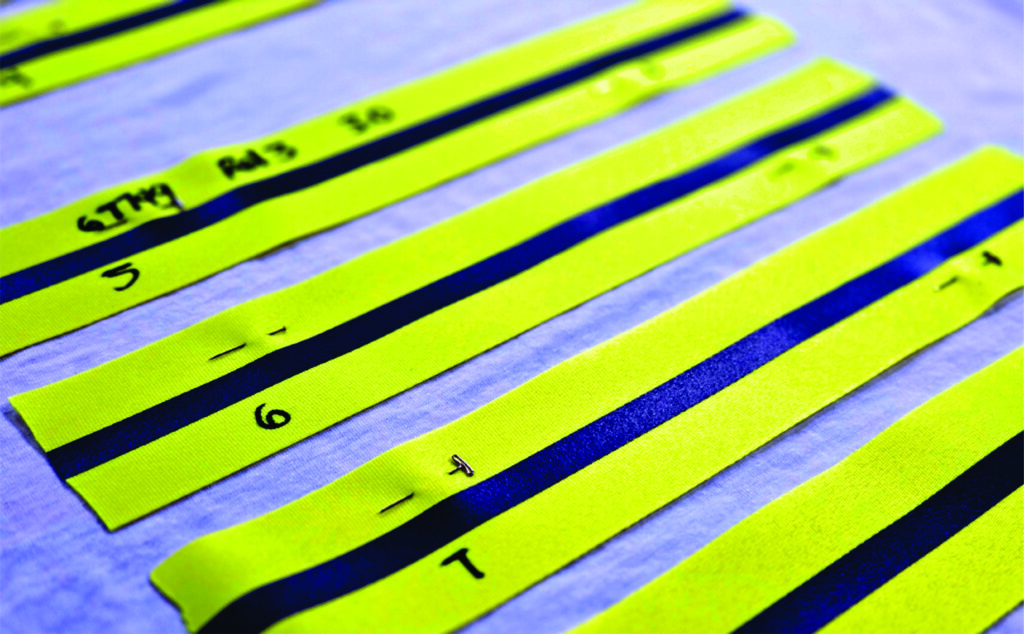
Based on extensive analysis from SRI Labs, this article explores five common failure mechanisms and provides the diagnostic tools needed to manage your HVSA inventory with confidence.
Reflective trim failures often appear gradually, and they are not always easy to see as they develop.
For safety managers, that’s not a product issue. It’s a worker safety issue.
High-visibility safety apparel (HVSA) often performs as expected during early inspection and initial deployment. Garments pass incoming checks, initial wear looks acceptable, and reflectivity meets requirements. Over time, laundering, heat exposure, abrasion, and field use begin to take a toll. In many cases, performance degrades incrementally, but without specialized measurement tools, those losses can be difficult to detect until reflectivity drops below safe or acceptable thresholds.
When that happens, the issue is no longer a quality inconvenience. It becomes a critical safety exposure. Reduced visibility puts workers at risk, introduces uncertainty on job sites, and forces reactive decisions that safety managers are often left to manage after the fact.
At Safe Reflections, Inc., these failure patterns have been studied repeatedly through SRI Labs. Over decades of testing, diagnostics, and field investigation, one conclusion is consistent: most reflective trim failures are not caused by the trim alone. They are the result of interactions between reflective material, fabric, coatings, heat, laundering chemistry, and manufacturing processes. Interactions that are often invisible until performance fades.
Together, these factors determine whether reflective trim performance holds up against high-visibility garment requirements once garments enter real-world use.
This blog discusses five of the most common reasons reflective trim fails safety testing, how those failures present in real-world use, and provides a diagnostic framework that occupational safety managers can use to reduce HVSA risk before garments reach the field.
How SRI Labs knows where failures begin
Before looking at the failure modes themselves, it’s worth understanding how this information is gathered.
SRI Labs, the testing and diagnostics division of Safe Reflections, Inc., works at the intersection of materials, process, and performance. The lab evaluates reflective trim not in isolation, but as part of a complete ecosystem: the fabric it’s applied to, the coatings present, the lamination method used, laundering method, and the conditions garments will face in service.
This system-level approach allows SRI Labs to identify reflective trim failure origins through controlled laboratory evaluation and field-relevant testing.
This includes:
- Pre-production testing on actual customer fabrics
- Lamination expertise across a wide range of equipment types and process conditions
- Wash durability evaluation under realistic industrial laundering conditions
- Heat and exposure testing to identify early compatibility limits
- Failure analysis when garments underperform in the field
Over time, our work has produced a clear picture, deep understanding, and extensive insights into how and why reflective trim fails. And, more importantly, how those failures can be prevented.
1 – Fabric coatings interfere with adhesion – often invisibly
One of the most common causes of reflective trim failure has nothing to do with the trim itself. It starts with fabric.
Many HVSA fabrics are treated with durable water-resistant (DWR) or similar coatings. These finishes are designed to repel moisture and improve garment performance. However, they can also interfere with the lamination process that bonds reflective trim to fabric.
The challenge is that coatings are not always applied evenly. Spray systems can vary across a fabric roll. Nozzles can partially clog. Coating consistency and quality can differ from one production lot to another. Two fabrics that look identical, and even meet the same specifications, can behave very differently once heat, pressure, and wash are introduced. This often catches safety managers off guard.
In many cases, pre-production adhesion testing can identify coating-related adhesion problems that create these adhesion breaks before garments are manufactured.
In cases where adhesion is compromised by fabric coatings, failure does not typically appear gradually. Reflective trim can delaminate quickly and extensively, sometimes affecting only specific garment components, such as pockets or panels, and sometimes impacting entire production runs.
Tip 1 – What safety managers should watch for:
- Reflective trim detaching cleanly from fabric rather than wearing down slowly
- Failures isolated to specific garment areas (for example, pockets but not body panels)
- Performance differences between garments made from “the same” fabric
- Sudden, widespread delamination following laundering
These patterns often indicate fabric compatibility issues rather than trim defects, and should be prioritized at the top of every HVSA safety review as “high-frequency failure mode.” Addressing this risk early is one of the most effective ways to prevent reflective trim delamination before garments reach the field.
2 – Industrial laundering accelerates reflective degradation
Industrial laundering environments are designed for aggressive soil removal, not for preserving reflective performance.
High chemical concentrations, strong detergents, elevated temperatures, and mechanical action can all affect reflective trim. In some cases, retroreflective glass beads gradually wear away over time, reducing brightness. In other cases, laundering exposes adhesion weaknesses that were not evident during initial inspection or early wear. And this can happen after one wash, or not until many washes later.
For safety managers, the risk lies in premature and unpredictable loss of reflectivity, especially when garments appear compliant early in their lifecycle but fail well before their expected service life. Industrial laundering cycle testing helps reveal whether reflective trim performance will hold up under real wash chemistry and mechanical stress.
Tip 2 – What safety managers should watch for:
- Reflectivity declining faster than anticipated based on garment lifecycle expectations
- Differences in performance between garments laundered under different wash programs
- Trim that meets requirements initially but degrades rapidly after repeated laundering
- Increased failures after changes in wash chemistry or laundry providers
Understanding how reflective safety materials respond to real-world laundering conditions is essential to evaluating long-term safety performance.
3 – Adhesion failures are systemic, not isolated
When reflective trim fails, it is often treated as an isolated defect. In reality, failures are frequently systemic.
Lot-to-lot fabric variation, uneven coatings, or differences in fabric sourcing can lead to widespread failures that affect many garments simultaneously. These issues may only become visible once production is underway, or after garments have already been issued and laundered.
Because the failure presents suddenly, it can be misattributed to misuse or handling, which delays proper diagnosis. SRI Labs has seen just about every possible HVSA failure scenario, and can get to the root cause of issues to identify what safety managers need to know. This diagnostic insight helps distinguish isolated damage from system-wide adhesion failure tied to fabric variability.
Tip 3 – What safety managers should watch for:
- Multiple garments failing within the same timeframe or production batch
- Similar failure patterns across different garments or wearers
- Reflective trim detaching in consistent ways across multiple items
- Issues emerging after a specific production window
These are strong indicators of upstream variability rather than isolated damage and provide a heads-up list for safety managers when evaluating products in the future.
4 – Heat exposure reveals compatibility issues early. Or, too late
Heat affects reflective trim throughout a garment’s lifecycle—not only in extreme environments, but also during processing and laundering.
The lamination process introduces heat and pressure that can expose incompatibilities between fabric, coatings, and adhesive systems. Later, during industrial laundering, elevated dryer temperatures can further stress reflective materials, particularly those applied using heat-activated or hotmelt adhesive systems. When re-heated, these adhesives can soften or partially re-melt, weakening the bond between trim and fabric.
Over time, repeated exposure to excessive heat can cause reflective trim to wrinkle, delaminate, or become more susceptible to abrasion damage. These effects may develop gradually, but they can significantly accelerate performance loss and increase the likelihood of visible failure in the field.
In fire-adjacent and high-heat environments, radiant heat adds another layer of stress. In these cases, heat exposure does not cause failure on its own so much as reveal compatibility limits that were present from the start.
Heat-related failures often reveal material incompatibilities that were present at the outset, but went undetected during standard inspection because people don’t always know to look for specific potential problems. SRI Labs looks at the full range of relevant issues before they become safety concerns, because evaluating reflective trim performance under realistic heat exposure conditions allows these risks to surface before garments are placed into service.
Tip 4 – What safety managers should watch for:
- Changes in reflectivity following exposure to elevated temperatures
- Trim failure after heat-intensive processing or use conditions
- Differences in performance between garments exposed to similar heat environments
- Loss of adhesion without visible fabric damage
Heat can act as an accelerant, turning marginal compatibility into visible failure.
5 – Upstream changes create downstream safety risk
One of the most challenging aspects of reflective trim performance is that changes upstream are not always visible downstream.
Fabric sourced from a different mill, subtle changes in finishing processes, or even a fabric being oriented differently during manufacturing can all affect adhesion and durability. These changes may still meet specification requirements while behaving very differently under heat and laundering.
For safety managers, this means that reflective performance risk can increase even when nothing appears to have changed on paper. After all, you can’t risk manage what you can’t see. This is why supplier changes, fabric sourcing shifts, and finishing variations should trigger renewed reflective trim compatibility review.
Tip 5 – What safety managers should watch for:
- Performance changes following supplier, mill, or sourcing adjustments
- Inconsistencies between production runs using “equivalent” materials
- Failures emerging without changes to garment design or trim selection
- Issues that appear only after new fabric lots are introduced
Product specifications alone do not necessarily guarantee consistent field performance. There are just way too many variables involved, which requires long expertise to understand and account for. Pre-production reflective trim testing helps account for those variables before they become safety liabilities.
Why pre-production testing reduces safety exposure
Across all five failure modes, one theme is consistent: HVSA reflective safety trim failures are preventable when the risks are identified early.
Pre-production testing allows reflective trim to be evaluated within the full system it operates. That is, actual fabric, real lamination conditions, realistic laundering, and expected heat exposure. This approach connects failure diagnostics directly to prevention, rather than relying on post-issue corrective action. When it comes to reflective safety, proactive is always better.
SRI Labs supports this process by:
- Identifying compatibility limitations before production
- Documenting fabric and process behavior across lots and conditions
- Recommending process adjustments or alternative solutions when needed
- Advising when a particular fabric-trim combination is not suitable
This work is not about forcing a product to fit a given application. It is about identifying compatibility limits early and ensuring reflective performance remains predictable in safety-critical environments.
Skipping the pre-production testing step can look like a time or cost savings up front. But it almost always reappears later as rework, disruption, or unacceptable safety exposure – usually at a far higher cost.
Plan for performance, not recovery
For safety managers, reflective trim is not a decorative feature or a procurement detail. It is a safety control.
Understanding why reflective trim fails, how failures present, and what warning signs to look for can help reduce uncertainty and protect workers in the field. This diagnostic knowledge allows safety managers to act before reflective performance loss becomes a field-level incident. Addressing these risks prior to garments being issued – or even manufactured – is significantly more effective and far less disruptive than responding after reflectivity declines in service.
To begin your pre-production reflective trim risk assessment, or to speak with an SRI expert about reflective performance in your program, contact the SRI Labs team.
Recent Resources

The Future of Visibility: How Reflective Graphic Transfers Are Transforming Safety Apparel
Reflective graphic transfers represent a genuine step forward in how reflective materials can be applied, designed, and integrated into modern safety garments,

Not All Reflective Materials Are Equal and the Difference Shows Up on the Job
Two reflective materials can look identical on a spec sheet and perform very differently in the field. After repeated washing, heat, and

ANSI in Action: Where HVSA Compliance on Paper Becomes Performance in the Field
There’s a question that keeps coming up at fire and safety tradeshows. Not about which standard applies, or whether an High-Visibility Safety